The simple answer is that IR35 does not affect sole traders. The IR35 legislation applies only to people who provide services through their own intermediary (often called a Personal Service Company). As sole traders do not operate as a separate legal entity, the legislation does not apply to them.
The more complicated answer? Although IR35 doesn’t apply to sole traders, employment status does - and the rules for determining employment status are very similar to the rules for determining IR35 status.
Just as IR35 is designed to tackle disguised employment of PSCs, similar rules exist to tackle disguised employment of sole traders. The way this operates in practice depends on whether sole traders are engaged directly by a hiring organisation, or placed through an agency.
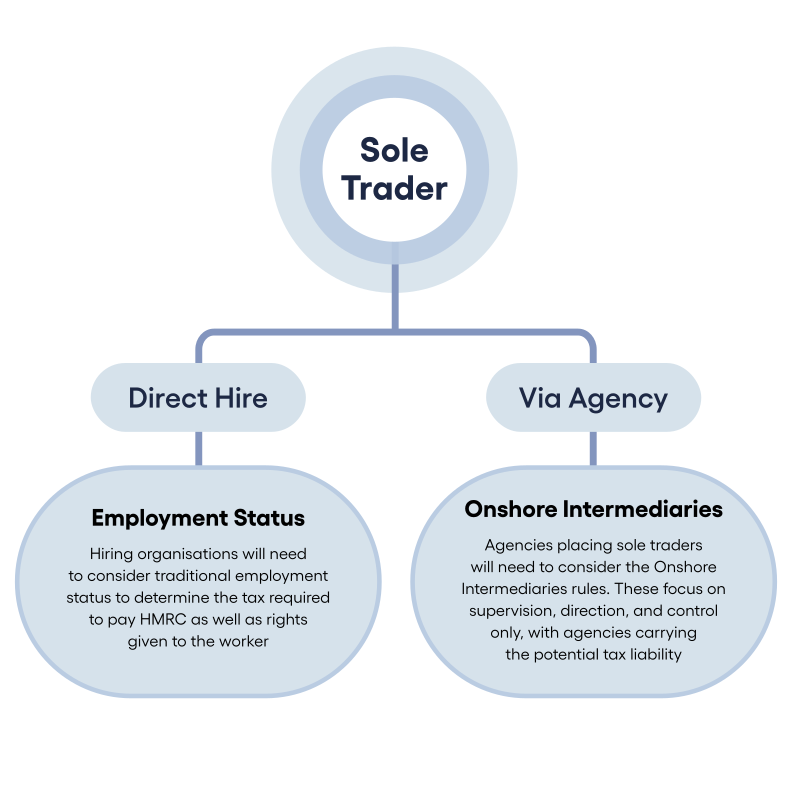
Before April 2014, the government noticed a rise in offshore employers sending workers to the UK for assignments with UK businesses while exploiting their offshore status to avoid paying income tax and National Insurance contributions (NICs) on those workers' earnings.
Since UK authorities had no jurisdiction over offshore employers, the government introduced legislative changes in 2014 to address the issue. These amendments became known as the Onshore Intermediaries Legislation and the Offshore Intermediaries Legislation.
Similarly to IR35 legislation, this focuses upon the presence of supervision, direction, and control (SDC) in an engagement in order to gauge employment status. In essence, any SDC exercised by an end client over the services provided by a sole trader could constitute an indicator of disguised employment.
Traditional employment status focuses upon the relationship between a directly engaged sole trader and their client.
The tests that determine traditional employment status are the same as those that determine the IR35 status of contractors.
For example:
HMRC also takes other factors into account, including whether or not sole traders take on any financial risk, whether they provide their own equipment, and how integrated they are into their client’s business.
Sole traders don’t carry any liability for their own employment status.
The client organisation is responsible for paying additional taxes, interest, and possibly penalties should a sole trader be considered an employee for tax purposes.
Client organisations have always held the responsibility for ensuring they are engaging sole traders under the correct employment status. However, sole traders may now find themselves becoming increasingly included within client status determination processes since IR35 reform in April 2021, with employment status now a more critical concern for compliance departments.
Whilst sole traders do not carry any liability, they could suffer a deduction from future earnings, as the likelihood is that they would be placed onto the payroll of the end client.
CEST is an HMRC tool that can be used to help determine whether a worker or a specific engagement should be classed as employed or self-employed for tax purposes.
Under the off-payroll working rules, there are certain circumstances in which self-employed professionals operating via their own limited company are responsible for determining their own status. This applies if the hiring organisation falls under the definition of ‘small’, as defined by the Companies Act 2006. Therefore, they may sometimes need to use CEST, or a similar status determination tool, to assess their employment status.
Read more: IR35 for small companies
However, when a sole trader is engaged, it is always the responsibility of the hiring organisation to determine employment status. They may or may not choose to use CEST as part of this determination.
To ensure compliance when engaging sole traders, there are a few steps businesses should implement.
Working practice assessments: When starting an engagement with a sole trader, businesses should assess how they will be working to decide their employment status. It's important to regularly check and update these assessments to make sure the worker's status stays accurate throughout the engagement.
Keep clear records: This might include notes about the working relationship, communication, and the tasks being done. Having clear records helps maintain transparency and provides proof if HMRC ever audits the business.
Maintain strong contracts, processes, and policies: A well-written contract is key to clearly stating the terms of the work arrangement. Businesses should also set up clear policies and processes to regularly assess and monitor the employment status of sole traders.
Undertake due diligence: Businesses should undertake proper due diligence to assure themselves that any self-employed worker is registered with HMRC, has a self-assessment number – known as a Unique Taxpayer Reference, and is filing tax returns.
Under these circumstances, the recruitment agency is responsible for determining employment status. They are required to assess the working relationship with the end client and decide whether a sole trader is employed or self-employed for tax purposes.

Ask away! One of our team will get back to you!
